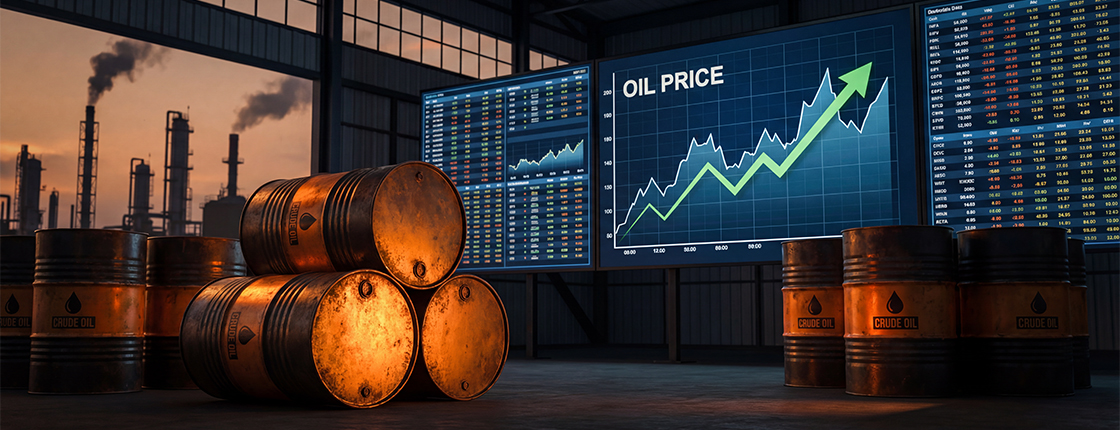
Crude oil is one of those assets that doesn’t just move charts, it moves countries. When oil spikes, Pakistan feels it through transport costs, imported inflation pressure, and a market mood that can flip in a day. That’s exactly why crude oil trading in Pakistan has become one of the highest-intent topics for beginners who want to graduate into serious trading. The market is liquid, it reacts to real headlines, and it trends hard when the world gets anxious.
But crude is also a market that exposes bad habits quickly. If you come in with overconfidence, oversized positions, and no stop discipline, crude won’t “teach” you. It will invoice you. That’s why a 2026-ready guide needs to be less about hype and more about process, regulation, risk control, and execution.
This blog is designed to take a beginner from “I want to trade crude oil” to “I know how to trade crude oil in Pakistan through PMEX with a rule-based approach.” It’s educational content, not financial advice. Futures trading involves high risk, and you should only trade with money you can afford to lose.
What you’re actually trading when you trade crude oil
Most people imagine crude oil trading as if they’re buying physical barrels. Retail traders aren’t doing that. When you trade crude oil through PMEX, you’re trading price exposure through standardized contracts. You’re not calling a tanker company. You’re taking a position on whether the market price is likely to rise or fall, and you’re managing that exposure using margin, stop-loss rules, and disciplined sizing.
Crude oil prices are influenced by supply, demand, currency strength, global interest rates, geopolitical risk, and investor sentiment. That means the market can move cleanly on fundamentals, and it can also whip around on rumors, unexpected news, or risk-off panic. The trader’s job is not to predict every move. The trader’s job is to build a framework that survives volatility and capitalizes on opportunities when the market is trending.
PMEX and why it matters for crude oil trading in Pakistan
PMEX exists to provide a structured and regulated environment for futures trading in Pakistan. It matters because structure is protection. Without a regulated framework, traders often end up in offshore environments with unclear rules, confusing fee structures, weak dispute mechanisms, and questionable execution quality.
A regulated setup does not remove trading risk, because market risk is always there. What it does is provide accountability, standardized contracts, defined trading rules, and a broker ecosystem that must operate under oversight. For beginners, that matters even more than “features,” because the biggest early risk is not strategy. The biggest early risk is getting trapped in a messy setup where you don’t fully understand what you signed up for.
If you’re still deciding whether your temperament fits commodities or equities better, you can naturally route readers to your internal article about PSX vs PMEX performance and the investor fit comparison between PSX and PMEX. Those links build trust and keep the reader inside your ecosystem while they decide.
Why crude oil is a top PMEX lead magnet in 2026
Crude oil is always in the news cycle, and people already care about it because it affects fuel prices and inflation. That makes it high intent. A beginner searching “crude oil trading Pakistan” is not browsing for entertainment. They’re usually either curious about getting started or they are already motivated by a recent price move and want to take action.
Crude is also volatile enough to create opportunity, and opportunity is what creates conversion. The trick for your brand is to handle that volatility responsibly in the content. That means you educate strongly, you avoid unrealistic promises, and you anchor everything in risk-first language. That’s what keeps it compliant, and that’s what builds trust that converts into serious clients instead of regretful gamblers.
How to trade crude oil in Pakistan through PMEX in 2026
The first step is choosing the right brokerage setup. In Pakistan, that means choosing a broker operating within the appropriate regulatory framework. Your content should guide the reader toward a regulated path, because if they start in a random offshore account, you lose control of the user experience and you risk the brand reputation.
After broker selection comes account opening and KYC. This is where your internal “Open PSX & PMEX Trading Account” guide becomes a natural bridge. Your blog should mention that the onboarding process is documented step-by-step in that guide, so the reader can move from education to action without confusion.
Once the account is opened, the trader funds the account. This is where beginners make the first big mistake: they treat funding as “how much can I deposit,” instead of treating it as “how much can I risk safely while learning.” For crude oil trading, the right starting capital is not only about meeting margin, it’s about having enough buffer to avoid forced decisions. A beginner who funds too small often ends up overleveraging just to “make it worth it,” and that’s how accounts blow up.
After funding, the trader chooses the contract size that suits their stage. PMEX offers multiple contract variants across commodities, and the exact specifications are product-defined. The key message is this: beginners should start with the smallest practical exposure so they can learn execution. Big size does not make you a trader. Big size just makes your mistakes expensive.
What moves crude oil prices and why it matters for traders
Crude oil responds to supply decisions and demand signals, but it also responds to fear. The market often prices in expectations before confirmation, and it often overshoots in both directions when liquidity is thin or when headlines shock the market.
Supply expectations are heavily influenced by production policy and major producer behavior. Demand expectations are influenced by global growth outlook, industrial activity, and risk sentiment. Inventory data can influence short-term movement because it signals whether supply is building or tightening.
Currency strength matters because oil is globally priced in USD, and a stronger dollar can pressure commodity pricing in many macro environments. Interest rate direction matters because rates change the cost of capital and overall risk appetite. Geopolitical risk matters because it adds uncertainty premium, especially when it involves regions that impact production or shipping routes.
The biggest mindset shift: crude is risk management first, prediction second
Most beginners believe trading is about being right. Professional trading is about controlling losses. If you can control losses, you give your winners room to breathe. If you can’t control losses, it doesn’t matter how often you’re right because one bad move can erase weeks.
So the goal in this guide is to teach the reader a structure where even if they’re wrong, they survive. Survival is not a motivational quote. Survival is a strategy. Surviving long enough is what allows skill to develop.
A simple, beginner-friendly framework for crude oil trading
A framework has to be simple enough that a beginner can follow it, and strict enough that it prevents the common mistakes. A good beginner framework starts with choosing a trading style that matches personality. Some people prefer fast trades and can handle quick decisions. Others prefer fewer trades and more patience. The mistake beginners make is choosing the most exciting style rather than the most sustainable style.
Intraday trading is often a balanced starting point because it allows structure while avoiding the rapid-fire stress of scalping. It also allows you to control exposure by ending the day flat if your plan requires it.
After choosing style, the trader chooses a method. The simplest method for beginners is trend-following. Trend-following means you try to trade in the direction the market is already moving, rather than trying to catch tops and bottoms. It’s not perfect, but it’s teachable and it reduces the need for constant prediction.
Execution rules then become the spine of the framework. You define what “entry” means, what invalidates the trade, where the stop belongs, and what profit-taking looks like. The goal is to remove improvisation from the process. Improvisation is where emotions sneak in.
Risk management that actually fits crude oil
In crude oil trading, stops are not optional. Not because stops magically protect you, but because they protect you from yourself. Without a stop, a small loss becomes a large loss, and a large loss becomes a decision made under stress.
Position sizing matters more than strategy. Even a good setup fails if you size too big. The correct approach is to decide the maximum you are willing to lose on a trade, then size the trade so that if your stop is hit, the loss stays within that maximum. That’s how you trade like a professional. Professionals think in losses first, not profits first.
Another risk rule is avoiding unplanned volatility. Crude can move violently around major news events, surprise headlines, and global shocks. A beginner does not need to trade every move. They need to trade the moves that fit their method. Sitting out is a strategy, not weakness.
Your content should also educate on the reality of margin. Margin magnifies outcomes. It can magnify profits, but it can magnify losses faster. Beginners often misunderstand that leverage is a tool, not a gift. Used responsibly, it improves capital efficiency. Used irresponsibly, it destroys accounts.
Tools and analysis: what you should use as a crude trader in Pakistan
A crude trader needs a clean charting setup and a consistent routine. A beginner should focus on price action clarity and basic market structure before drowning in indicators. Too many indicators create analysis paralysis and false confidence.
The most practical approach is to identify trend direction, key levels, and volatility zones. When the market is trending, your job is to ride with it and manage your exit. When the market is ranging, your job is to trade boundaries only if your system supports it or to stay out if the range is too noisy.
Volume can be useful depending on the platform and data availability, but beginners should not depend on complex interpretation early. The core skill is execution discipline.
Costs and practical realities in PMEX crude oil trading
Trading has costs. There can be broker commissions and execution spreads depending on the product and platform structure. A beginner should ask the broker for a transparent breakdown so there are no surprises.
There is also a hidden cost that most traders ignore: emotional slippage. Emotional slippage is when you exit late, enter early, or break rules because you feel fear or greed. That cost is often larger than commissions. The solution is rules and repetition.
Who should trade crude oil and who should avoid it
Crude oil is suitable for people who can follow rules and accept losses as part of the process. It is suitable for people who can focus on process over excitement. It’s a good market for traders who want a news-driven instrument but are willing to respect risk.
Crude oil is not suitable for someone seeking daily guaranteed income. It is not suitable for someone who refuses to use stops. It is not suitable for someone who gets emotionally triggered by losses and becomes impulsive. Those people can still learn, but they should start with education and simulation before risking money.
The bottom line for 2026
Crude oil trading in Pakistan through PMEX can be a serious opportunity for traders who approach it with discipline. It is not a shortcut. It is not a guarantee. It is a skills game, and skills take repetition and patience.
If you treat crude like a business, it can reward you. If you treat it like a casino, it will eventually collect its dues. The difference between those two outcomes is not luck. It’s process.